What is an adjective?
Read here about adjectives

One of the most important components of a sentence is the adjective. This part of speech is so common that people use it almost automatically, both in speech and in writing. For you to understand the concept of adjectives better this article will answer the following questions:
- What is an adjective?
- What are the functions of adjectives?
- What are the different kinds of adjectives?
- What are the degrees of adjectives?
Aside from answering the basic questions and defining the related terms, various examples will also be included in this short write-up.
What is an Adjective and its Functions?
An adjective is a part of speech which describes, identifies, or quantifies a noun or a pronoun. So basically, the main function of an adjective is to modify a noun or a pronoun so that it will become more specific and interesting. Instead of just one word, a group of words with a subject and a verb, can also function as an adjective. When this happens, the group of words is called an adjective clause.
For example:
- For example: My brother, who is much older than I am, is an astronaut.
In the example above, the underlined clause modifies the noun ”brother.” But what if the group of words doesn’t have a subject and a verb? What do you think the resulting group of words will be called?
If you think it’s called an adjective phrase, you are right. As you might recall, phrases and clauses are both groups of words and the main difference is that clauses have subjects and verbs, while phrases don’t.
- For example: She is prettier than you.
What are the Different Kinds of Adjectives?
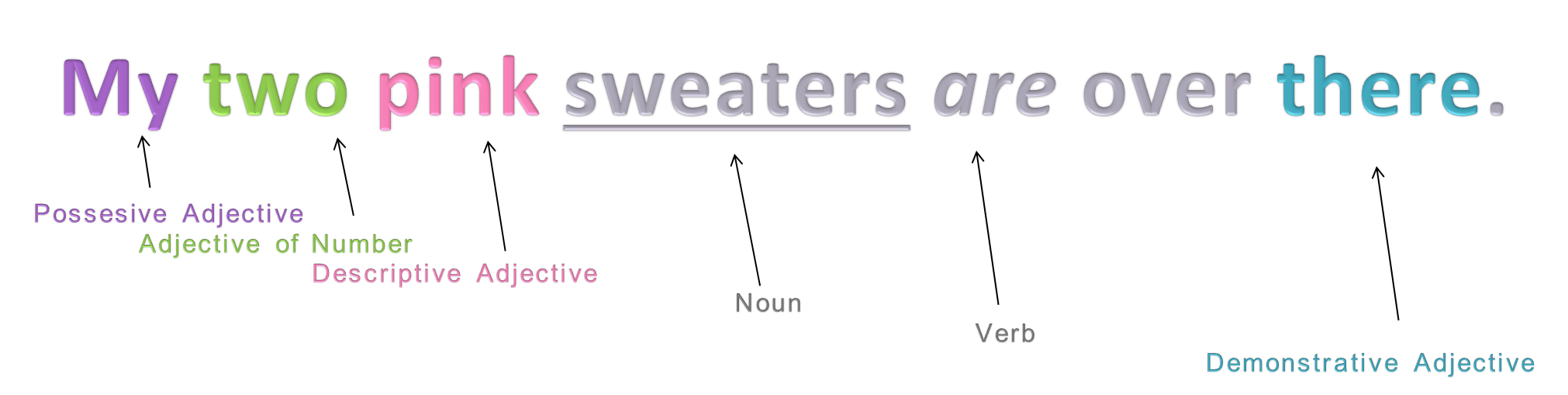
Now that you already know the answer to the question, “What is an adjective?” you should know that not all adjectives are the same. They modify nouns and pronouns differently, and just like the other parts of speech, there are different kinds of adjectives. These are:
1. Descriptive Adjectives
Among the different kinds of adjectives, descriptive adjectives are probably the most common ones. They simply say something about the quality or the kind of the noun or pronoun they’re referring to.
Examples:
- Erika is witty.
- She is tired.
- Adrian’s reflexes are amazing.
2. Adjectives of Number or Adjectives of Quantity
As the name suggests, this kind of adjective answers the question, “How many?” or “How much?”
Examples:
- Twenty-one students failed the exam.
- The plants need more water.
3. Demonstrative Adjectives
Demonstrative adjectives point out pronouns and nouns, and always come before the words they are referring to.
Examples:
- I used to buy this kind of shirts.
- When the old man tripped over that wire, he dropped a whole bag of groceries.
4. Possessive Adjectives
Obviously, this kind of adjectives shows ownership or possession. Aside from that, possessive adjectives always come before the noun.
Examples:
- I can’t answer my seatwork because I don’t have a calculator.
- Trisha sold his dog.
5. Interrogative Adjectives
Interrogative adjectives ask questions and are always followed by a noun.
Examples:
- What movie are you watching?
- Which plants should be placed over here?
What are the Degrees of Adjectives?
There are only three degrees or levels of adjectives (also known as degrees of comparison) namely, positive, comparative, and superlative. When you talk about or describe only a single person, place, or thing, you should use the positive degree.
Examples:
- She is a beautiful lady.
- It was a memorable trip.
If on the other hand, you are comparing two persons, places, or things, it is appropriate to use the comparative degree of the word. Normally, you will need to add “-er” to transform the word into its comparative form or add the word “more.” Also, the word “than” should be added after the adjective in the comparative degree.
Examples:
- This swimming pool is bigger than that one.
- Ashley is more intelligent than Aldrin.
*Note: For words ending in “y,” you should first change the “y” into “i,” and then add “-er” (e.g., lovely-lovelier; pretty- prettier; tasty- tastier)
Lastly, if you are comparing more than two things, the superlative form of the adjectives should be used and the word “the” should be added before the adjective. In order to transform the adjective into its superlative form, you just have to add the suffix “-est” or the word “most.”
Examples:
- That is by far, the tallest tree I have ever seen in my entire life.
- This is the most crucial match of the season.
*Note: For words ending in “y,” you should first change the “y” into “i,” and then add “-est” (e.g., lovely-loveliest; pretty- prettiest; tasty- tastiest)
Final Thoughts
This article entitled “Basic Grammar: What is an Adjective?” can be very helpful for beginners who want to improve their grammar skills and ace the English subject. If you really have a deep understanding of what is an adjective, you will surely be able to apply this concept to your compositions properly. Just remember that although adjectives seem a little trivial, an effective use of this part of speech can actually strengthen your writing.
| Appearance Adjectives
adorable
beautiful clean drab elegant fancy glamorous handsome long magnificent old-fashioned plain quaint sparkling ugliest unsightly wide-eyed | Color Adjectives
red
orange yellow green blue purple gray black white | Condition Adjectives
alive
better careful clever dead easy famous gifted helpful important inexpensive mushy odd powerful rich shy tender uninterested vast wrong |
Feelings (Bad) Adjectives
angry
bewildered clumsy defeated embarrassed fierce grumpy helpless itchy jealous lazy mysterious nervous obnoxious panicky repulsive scary thoughtless uptight worried |
Feelings (Good) Adjectives
agreeable
brave calm delightful eager faithful gentle happy jolly kind lively nice obedient proud relieved silly thankful victorious witty zealous | Shape Adjectives
broad
chubby crooked curved deep flat high hollow low narrow round shallow skinny square steep straight wide | Size Adjectives
big
colossal fat gigantic great huge immense large little mammoth massive miniature petite puny scrawny short small tall teeny teeny-tiny tiny | Sound Adjectives
cooing
deafening faint hissing loud melodic noisy purring quiet raspy screeching thundering voiceless whispering |
| Time Adjectives
ancient
brief early fast late long modern old old-fashioned quick rapid short slow swift young | Taste/Touch Adjectives
bitter
delicious fresh greasy juicy hot icy loose melted nutritious prickly rainy rotten salty sticky strong sweet tart tasteless uneven weak wet wooden yummy | Touch Adjectives
boiling
breeze broken bumpy chilly cold cool creepy crooked cuddly curly damaged damp dirty dry dusty filthy flaky fluffy freezing hot warm wet |
Quantity Adjectives
abundant
empty few full heavy light many numerous sparse substantial |
Leave a Comment